
How Much Flow Capacity Can a Centrifugal Screen Basket Handle
Welcome to Hebei YUBO Filtration Equipment Co.,Ltd.
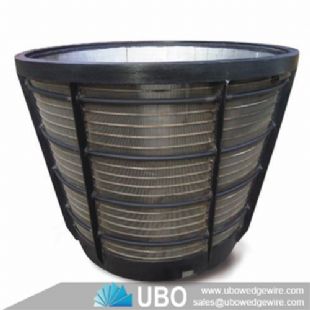
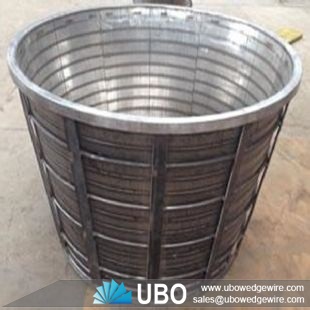
In industrial dewatering and solid-liquid separation systems, flow capacity is one of the most important performance indicators of a centrifugal screen basket. Whether in coal processing, starch production, salt processing, or chemical industries, the basket must handle large slurry volumes while maintaining stable separation efficiency and low moisture content.
However, many operators assume that increasing basket size alone automatically increases throughput. In reality, centrifugal basket flow capacity depends on a balance between open area, slot design, feed concentration, rotational speed, and material characteristics.
A poorly matched basket may process high flow temporarily but suffer from rapid clogging, excessive wear, vibration, or reduced separation efficiency.
What Does Flow Capacity Mean?
Flow capacity refers to the amount of slurry or feed material a centrifugal screen basket can continuously process over time.
Industrial systems commonly measure capacity in:
m³/h (cubic meters per hour)
TPH (tons per hour)
GPM (gallons per minute)
Depending on application type, centrifugal baskets may handle:
| Industry |
|
||
| Starch Processing | 20–80 m³/h | ||
| Coal Dewatering | 50–300 TPH | ||
| Sugar Industry | 30–120 m³/h | ||
| Wastewater Sludge | 10–60 m³/h |
The actual capacity depends heavily on operating conditions and basket design.
The Relationship Between Open Area and Throughput
One of the most critical factors affecting flow capacity is the screen open area.
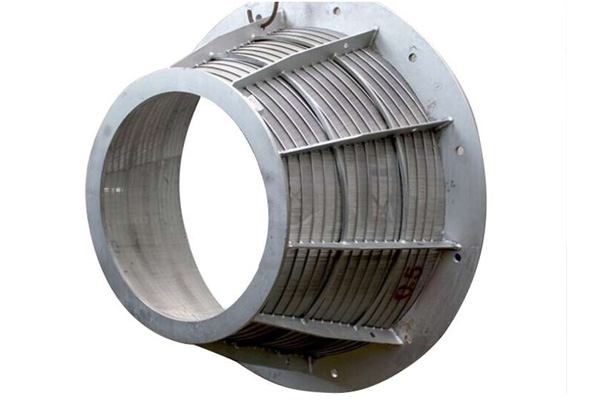
A wedge wire centrifugal basket with a 25–35% open area can usually process significantly more slurry than a perforated plate basket with only 10–18% open area.
Higher open area provides:
Faster liquid discharge
Lower flow resistance
Reduced pressure buildup
Improved dewatering efficiency
For example:
A 0.35 mm slot wedge wire basket may handle 20–40% higher throughput than a comparable perforated basket in starch processing applications.
However, increasing open area excessively can weaken structural strength if the basket is not properly reinforced.
How Slot Size Affects Capacity
Slot opening size directly controls both flow rate and particle retention.
Typical industrial slot sizes include:
| Application | Common Slot Size |
| Starch Processing | 0.15–0.45 mm |
| Coal Dewatering | 0.25–0.75 mm |
| Sugar Separation | 0.20–0.50 mm |
| Wastewater Treatment | 0.30–1.00 mm |
Larger slots improve drainage and increase flow capacity, but oversized openings may allow fine solids to pass through.
For example:
Increasing slot size from 0.25 mm to 0.50 mm may increase flow capacity by 15–30%, depending on slurry viscosity and particle size distribution.
The challenge is finding the balance between throughput and separation precision.
Rotational Speed and Centrifugal Force
Centrifugal baskets typically operate between:
800–2,500 RPM in medium-duty applications
Up to 3,500 RPM in high-speed industrial centrifuges
Higher rotational speed generates greater centrifugal force, which improves:
Liquid removal rate
Solids dryness
Processing speed
But excessive speed also increases:
Basket wear
Mechanical stress
Vibration risk
Energy consumption
In abrasive applications such as coal slurry dewatering, excessive RPM may reduce basket service life by more than 30%.
Feed Characteristics Can Limit Capacity
Even with a high-performance basket, feed conditions strongly influence actual throughput.
Several material properties affect capacity:
Solids concentration
Particle size
Slurry viscosity
Fiber content
Abrasiveness
For example:
A low-viscosity starch slurry may flow easily at 60 m³/h
A high-density mineral slurry using the same basket may only process 25–35 m³/h efficiently
This is why basket selection must always match the actual operating environment.
Why Wedge Wire Baskets Perform Better
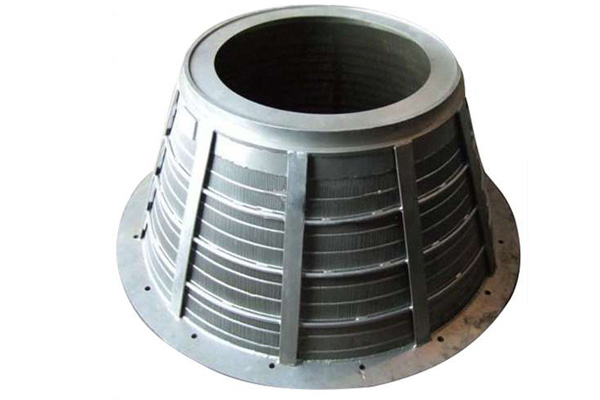
Modern industrial centrifuges increasingly use stainless steel wedge wire screen baskets because they combine high capacity with strong structural durability.
Compared to perforated plates or mesh screens, wedge wire baskets offer:
Higher open area
Continuous slot openings
Better anti-clogging performance
Lower pressure resistance
Improved wear resistance
The also reduces particle buildup, allowing more stable flow under continuous operation.
In many industrial applications, wedge wire baskets can improve operational efficiency while extending maintenance intervals.
FAQ
What is the average flow capacity of a centrifugal screen basket?
Industrial centrifugal baskets may handle anywhere from 10 m³/h to over 300 TPH depending on basket size, slot design, and application type.
Does larger slot size always increase flow capacity?
Generally yes, but oversized slots may reduce separation accuracy and allow fine particles to pass through.
How does open area affect basket throughput?
Higher open area improves liquid discharge efficiency and usually increases overall flow capacity while reducing pressure resistance.
Why does basket clogging reduce throughput?
Clogged slots reduce effective open area, increase pressure resistance, and limit liquid discharge efficiency.
Why are wedge wire centrifugal baskets widely used?
Because they provide high open area, strong mechanical strength, better anti-clogging performance, and longer service life in demanding industrial environments.
Who We Are?
YUBO Company is the professional supplier in China. It is always committed to study, design and produce wedge wire screen products for industry filter.Now its products include wedge wire screen panel, filter nozzle, cylinder,basket,pipe, Sieve Bend Screen,Profile Screen Laterals,etc.
What Is wedge wire screen
Wedge Wire Screens is a sieve made from looped wires formed into a deep wedge-shaped section. The wedge wire screens can be supplied in various shapes and forms as FLAT PANELS, CURVED SIEVE BENDS, CONICAL BASKETS, CYLINDERS, TROUGHS DISKS either in one one piece or in segments.
our advantages
- Professtional, we have our Engineering designers
- We are the factory
- Quality is our cluture and soul
- Customized. We produce and design according to your need
- Low cost and high efficient
Compare Products